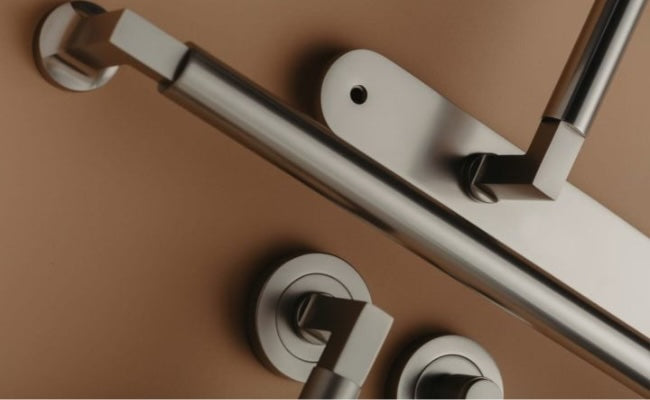

Article: How to choose drawer handles for your kitchen
How to choose drawer handles for your kitchen

Cabinet hardware may be one of the smaller details in a kitchen, but it can have a surprisingly significant impact on the finished space.
The right drawer handles should feel considered alongside the cabinetry, benchtop, tapware and appliances, while also being comfortable and practical to use every day.
From handle size and placement to choosing between knobs and pulls, here are the key details to consider when selecting hardware for your kitchen.
START WITH THE STYLE OF THE KITCHEN
Before choosing individual drawer handles, consider the overall language of the kitchen.
Clean, minimal cabinetry often works beautifully with simple linear handles or understated pulls. More traditional or detailed cabinetry can suit hardware with softer forms, subtle detailing or classic proportions.
The aim isn't necessarily to match the hardware to the cabinetry perfectly. A carefully chosen handle can introduce contrast, texture or character while still feeling connected to the wider interior.
CONSIDER SCALE AND PROPORTION
One of the most important considerations when choosing drawer handles is proportion.
A handle that looks beautifully balanced on a narrow drawer can appear undersized on a wide pot drawer. Likewise, an oversized pull can overwhelm a smaller cabinet front.
Rather than using one handle size throughout the entire kitchen, consider using different lengths from the same collection.
Smaller handles or knobs can work well on narrow drawers and doors, while longer handles can create better visual balance on wider drawers and cabinetry.
For particularly wide drawers, a longer pull often creates a cleaner result than two smaller handles.

HANDLES OR KNOBS?
You don't necessarily have to choose one or the other.
Combining cabinet knobs with drawer handles can create a layered, considered look and is particularly effective when the pieces belong to the same collection or share a common finish.
A common approach is to use knobs on cabinet doors and handles on drawers. Handles provide an easy grip for heavier drawers, while knobs can introduce a smaller architectural detail to doors and upper cabinetry.
The important thing is consistency. Repeating shapes, finishes or design details throughout the kitchen helps different pieces of hardware feel intentional together.

THINK ABOUT HOW THE HANDLE FEELS
Hardware is something you physically interact with every day, so appearance shouldn't be the only consideration.
Think about how comfortably your fingers fit behind a handle, whether the edges feel pleasant to hold and how easily a drawer can be opened.
This becomes particularly important for large drawers containing cookware, pantry items or other heavier contents.
Good hardware should feel as considered in the hand as it looks on the cabinetry.
CHOOSING THE RIGHT FINISH
The finish of your drawer handles can subtly change the character of the entire kitchen.
Warm brass and bronze finishes can bring depth and warmth to timber, stone and painted cabinetry, while nickel and silver-toned finishes can create a quieter, more contemporary feel.
Rather than looking at the hardware finish in isolation, consider it alongside the other materials in the room — particularly tapware, appliances, lighting, benchtops and cabinetry.
These finishes don't necessarily need to match exactly. A considered mix of metals can often create a more layered interior than using one identical finish throughout.
SHOULD YOUR HARDWARE MATCH YOUR TAPWARE?
Not necessarily.
Matching tapware and cabinet hardware can create a cohesive look, but complementary finishes can work just as beautifully.
The key is to consider undertone and character. Warm metals generally sit comfortably alongside other warm finishes, while cooler nickel and stainless tones often work naturally together.
If you're mixing finishes, repetition helps. Using each finish more than once within the space makes the combination feel deliberate rather than accidental.
CONSIDER PLACEMENT BEFORE INSTALLATION
Handle placement has a significant impact on the finished cabinetry.
On drawers, handles are generally centred horizontally, although their vertical position may vary depending on the proportions and style of the drawer front.
For cabinet doors, placement should feel consistent throughout the kitchen and comfortable to reach.
Before drilling cabinetry, it's worth temporarily positioning the hardware with removable tape or a template. Even a small adjustment can noticeably improve the visual balance.
And always measure carefully — once the cabinetry is drilled, changing the position becomes considerably more difficult.
DON'T FORGET APPLIANCE PULLS
Integrated refrigerators, freezers and dishwashers often require larger hardware than standard cabinetry.
Using an appliance pull from the same collection as your cabinet and drawer handles can create continuity while providing the scale and strength required for larger integrated doors.
This is particularly effective in kitchens where appliances are designed to disappear into the surrounding cabinetry.
CHOOSE HARDWARE AS PART OF THE WHOLE PALETTE
The most successful hardware selections rarely happen in isolation.
Consider your drawer handles alongside cabinetry, stone, timber, tapware, lighting and appliances. Looking at physical samples together can make it much easier to understand how finishes and proportions interact.
Ultimately, the right cabinet hardware should feel like part of the architecture of the kitchen - functional, tactile and quietly considered.
Explore our collection of Cabinet & Drawer Handles and Cabinet Knobs to discover hardware for contemporary New Zealand interiors.